
We Called It Romance, But Was It? Bollywood Love Stories That Hit Differently Today
From RHTDM’s deception to Kabir Singh’s possessiveness, these 15 Bollywood films invite a fresh look at what we once celebrated as romance.

IST
Last Updated On
IST
Bollywood gave us rain-soaked declarations, grand gestures and songs capable of turning an ordinary commute into a personal music video. It also gave us heroes who treated rejection as a temporary setback, jealousy as proof of devotion and a heroine’s boundaries as something to negotiate. Revisit certain favourites today, and the soundtrack still works beautifully. The relationship advice? That deserves another listen.
With ‘Rehnaa Hai Terre Dil Mein’ having completed 25 years on October 19, there is a timely reason to revisit the difference between irresistible screen chemistry and a relationship we would actually recommend. Dia Mirza has been celebrating the film’s enduring appeal, while its central deception remains a revealing starting point for that conversation.
These films have different intentions, and several faced criticism on their original release. Some deliberately give their protagonists destructive flaws; others build towards personal growth. The interesting question is how their storytelling asks us to respond when pursuit becomes pressure, protection becomes control, or forgiveness arrives surprisingly quickly.
Here are 15 Bollywood love stories that invite a more complicated second look.
1. Rehnaa Hai Terre Dil Mein (2001)
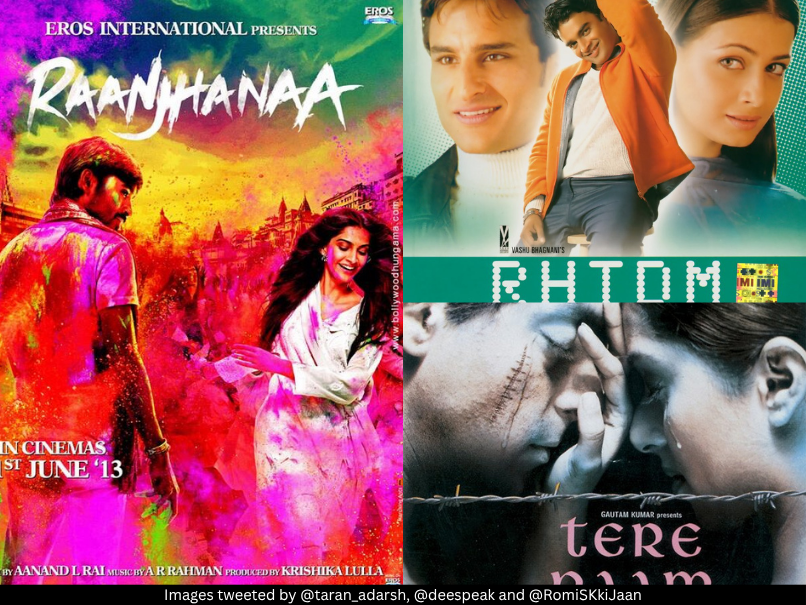
Directed by Gautham Vasudev Menon and released on October 19, 2001, ‘Rehnaa Hai Terre Dil Mein’ stars R. Madhavan, Dia Mirza and Saif Ali Khan, with Anupam Kher in a supporting role. Maddy falls for Reena, discovers that she has never met her prospective husband, Rajeev, and impersonates him to get close to her. The complication becomes personal when the real Rajeev turns out to be Maddy’s old college rival. It is an extremely efficient romantic shortcut - provided nobody asks Reena whether she would like the correct information first.
That is where the romance becomes harder to surrender to. Reena’s initial trust develops around a false identity, yet the film’s emotional momentum encourages us to root for the impersonator. Her eventual feelings do not erase the deception that created their intimacy. Madhavan and Dia Mirza make the connection persuasive on screen; watching it today means holding that chemistry alongside a much less dreamy question about honesty and informed choice.
2. Tere Naam
The centre-parted hairstyle became instantly recognisable, but Radhe’s approach to love deserves rather less imitation. Salman Khan and Bhumika Chawla lead Satish Kaushik’s ‘Tere Naam’, released on August 15, 2003, with Ravi Kishan and Sachin Khedekar among the supporting cast. Radhe’s fixation on Nirjara mixes vulnerability with intimidation, aggression and a refusal to respect boundaries. The film eventually becomes a devastating tragedy, making sympathy for his suffering a major part of its emotional pull.
That tragic framing matters: this is no uncomplicated happily-ever-after. Still, it is possible to feel for Radhe without treating the intensity of his obsession as evidence of healthy love. Salman himself has repeatedly said that audiences could watch the film and copy the hairstyle, but should avoid copying the character’s personality. When even the actor draws that distinction, there is good reason to look beyond the heartbreak and examine what Nirjara experiences along the way.
3. Raanjhanaa (2013)
Dhanush, Sonam Kapoor and Abhay Deol star in Aanand L. Rai’s ‘Raanjhanaa’, which released on June 21, 2013, alongside Swara Bhasker and Mohammed Zeeshan Ayyub. Between Dhanush’s performance and A.R. Rahman’s music, Kundan’s longing has enormous cinematic force. His pursuit of Zoya, however, also involves stalking and self-harm used within the courtship narrative.
A rewatch shifts attention from the size of Kundan’s feelings to the pressure they place on Zoya. Loving someone intensely cannot make their affection an obligation. The film grows into a story of political ambition, betrayal and destructive choices, giving its characters more complexity than a simple romantic fantasy. Yet its early courtship remains an uncomfortable example of how a magnetic performance can make relentless pursuit feel more enchanting than the behaviour itself.
4. Dil (1990)
Released on June 22, 1990, Indra Kumar’s ‘Dil’ stars Aamir Khan and Madhuri Dixit, with Anupam Kher and Saeed Jaffrey as their fathers. Raja and Madhu begin as sparring college students before becoming lovers battling parental opposition. But the bridge between those two stages is particularly disturbing: Madhu makes a false accusation of sexual assault, and Raja subsequently threatens her with rape before letting her go. Their romance develops after this confrontation.
Both actions warrant scrutiny. Her false allegation is serious, while his threat turns fear of sexual violence into a supposed lesson. The fact that he does not carry it out is a crucial plot distinction; it does not make the threat romantic. Add a college boxing bet that treats a kiss from Madhu as a prize, and the film’s playful surface becomes considerably less playful. The songs and performances retain their appeal, but that route from hostility to affection is a difficult one to celebrate.
5. Ishq Vishk (2003)
Before Shahid Kapoor became Kabir Singh, his debut hero already had some growing up to do. Ken Ghosh’s ‘Ishq Vishk’, released on May 9, 2003, stars Shahid Kapoor, Amrita Rao and Shenaz Treasurywala, with Vishal Malhotra, Yash Tonk and Satish Shah in supporting roles. Rajiv initially pretends to reciprocate his friend Payal’s love because he needs a girlfriend to join a couples-only trip. At the picnic, he makes unwanted advances while intoxicated; their fallout precedes his relationship with Alisha.
The film recognises Rajiv’s immaturity and eventually has him understand his feelings for Payal. Even so, a rewatch makes the cost of his learning curve harder to ignore. Payal’s affection is first useful to him, then inconvenient when she asserts a boundary. Beneath the breezy college comedy sits a pointed question: how much hurt must the loyal girl absorb while the hero discovers that she deserved respect all along?
6. Kuch Kuch Hota Hai (1998)
Basketball, friendship bands and one very emotional summer camp: Karan Johar’s ‘Kuch Kuch Hota Hai’ remains packed with instantly recognisable images. Released on October 16, 1998, it stars Shah Rukh Khan, Kajol and Rani Mukerji, with Salman Khan in a special appearance, alongside Farida Jalal, Anupam Kher and Sana Saeed. Rahul loves Tina during college, while his best friend Anjali quietly loves him. Years later, after Tina’s death, he reconnects with an Anjali whose appearance is now more conventionally feminine.
Time, grief and maturity all separate their two meetings. Nevertheless, the visual contrast invites an awkward question: why does the friend who was always there become romantically visible after the long hair and sarees arrive? Johar has acknowledged problems with the film’s gender politics and recalled Shabana Azmi challenging precisely this transformation. That admission gives the conversation extra weight. Viewers can still melt at Rahul and Anjali’s reunion while questioning the beauty standards through which the film presents it.
7. Raja Hindustani (1996)
Aamir Khan and Karisma Kapoor headline Dharmesh Darshan’s ‘Raja Hindustani’, released on November 15, 1996, with Suresh Oberoi, Archana Puran Singh and Johnny Lever among the cast. Its central romance brings together a taxi driver and a wealthy young woman, but the class divide is only part of the friction. In a revealing sequence, Raja disapproves of Aarti’s red dress; after she faces harassment, their argument returns to what she should wear.
Here, the protective-hero fantasy comes with conditions. Raja’s willingness to confront harassers does not entitle him to supervise Aarti’s clothes, and blaming her appearance shifts attention away from the men responsible. The film also subjects their marriage to scheming relatives and misunderstandings, so his behaviour is not the only cause of their problems. But a fresh viewing makes the distinction between defending someone and controlling them particularly hard to overlook.
8. Badrinath Ki Dulhania (2017)
Shashank Khaitan’s ‘Badrinath Ki Dulhania’, released on March 10, 2017, stars Varun Dhawan and Alia Bhatt, supported by Sahil Vaid, Rituraj Singh and Shweta Basu Prasad. Vaidehi wants an independent working life; Badri has grown up inside a patriarchal household that treats marriage very differently. The film challenges dowry and ultimately pushes him towards respecting women’s choices. Along that journey, however, he follows Vaidehi to Singapore and abducts her, putting her in a car boot.
That sequence is difficult to fold into the film’s otherwise buoyant romantic register. Badri’s anger after Vaidehi leaves their wedding is given considerable emotional space, while the seriousness of what he does to her passes surprisingly quickly. His eventual growth is essential to the story, and Vaidehi’s ambition is treated as legitimate. The tension lies in how much the romance asks her — and the audience — to move past before arriving at that more progressive ending.
9. Kabir Singh (2019)
Shahid Kapoor and Kiara Advani lead Sandeep Reddy Vanga’s ‘Kabir Singh’, released on June 21, 2019, with Soham Majumdar, Arjan Bajwa and Suresh Oberoi in key supporting roles. The Hindi remake of ‘Arjun Reddy’ centres on a brilliant medical student whose relationship and subsequent separation spiral into addiction and destructive behaviour. His treatment of Preeti includes asserting ownership over her, deciding aspects of her college life and physically assaulting her.
This one requires a clear qualification: its romantic politics were fiercely criticised in 2019 itself. Rewatching it continues an existing debate about how the film packages possessiveness and aggression through star charisma, music and emotional suffering. A flawed protagonist can make compelling cinema. The more difficult question is what happens when his pain receives so much narrative attention that the woman experiencing his control has comparatively little room to speak.
10. Dilwale Dulhania Le Jayenge (1995)
The mustard fields still look glorious, but a few moments deserve a closer look. Aditya Chopra’s ‘Dilwale Dulhania Le Jayenge’, released on October 20, 1995, stars Shah Rukh Khan and Kajol, alongside Amrish Puri, Farida Jalal and Anupam Kher. During their European adventure, Raj briefly tricks an anxious Simran into believing they have slept together after a drunken evening. His eventual reassurance establishes his honour within the film, but her distress makes the joke uncomfortable to revisit.
Then there is that famous railway-platform permission slip. Simran knows whom she loves, yet the resolution depends on her father finally releasing her hand. Raj’s determination to win over her family gives the romance its emotional appeal, while also placing parental approval above her expressed wishes. Simran does challenge the life planned for her; the tension is that her choice becomes acceptable only when the patriarch agrees. The train sequence can still produce goosebumps while leaving that question hanging in the air.
11. Cocktail (2012)
With its London setting, breezy friendships and irresistible music, ‘Cocktail’ initially looks like a thoroughly modern romance. Released on July 13, 2012, Homi Adajania’s film stars Saif Ali Khan, Deepika Padukone and Diana Penty, supported by Dimple Kapadia, Boman Irani and Randeep Hooda. Gautam enters a casual relationship with party-loving Veronica, but develops feelings for her more traditionally presented friend Meera, who also wins his mother’s approval. The triangle invites scrutiny of the familiar divide between a woman considered exciting company and one considered suitable for marriage.
Veronica’s warmth towards Meera makes that contrast especially uncomfortable: the supposedly unsuitable woman is also the person who offers her a home. The issue is less that Gautam must love Veronica than the standards through which the women are compared. Saif himself acknowledged a “slightly regressive script choice” in a September 2026 interview.
12. Ae Dil Hai Mushkil (2016)
Unrequited love gets a spectacular soundtrack in Karan Johar’s ‘Ae Dil Hai Mushkil’, released on October 28, 2016. Ranbir Kapoor, Anushka Sharma and Aishwarya Rai Bachchan lead the film, with Fawad Khan in a supporting role. Ayan falls for Alizeh, who values their friendship but does not return his romantic feelings. His subsequent relationship with poet Saba cannot extinguish that longing. The emotional imbalance drives the story, but also makes Ayan’s repeated difficulty accepting Alizeh’s answer exhausting to watch.
A rewatch can make Alizeh’s position feel clearer than the sweeping declarations surrounding her: she should be able to offer friendship without having to defend its worth against romance. Importantly, the film does not resolve this by making her fall in love with Ayan; it eventually recognises the significance of their platonic bond. That gives the story a useful contradiction to explore. Its heartbreak can be moving even when the pressure placed on the person who cannot reciprocate feels deeply unfair.
13. Tanu Weds Manu (2011)
The soft-spoken suitor can slip past our romantic radar more easily than the swaggering troublemaker. Aanand L. Rai’s ‘Tanu Weds Manu’, released on February 25, 2011, stars R. Madhavan and Kangana Ranaut, alongside Jimmy Sheirgill, Deepak Dobriyal, Swara Bhasker and Eijaz Khan. London-based doctor Manu arrives in India to find a bride and becomes smitten with Tanu during their arranged meeting. But she is passed out, and he secretly photographs her.
What the film presents through bashfulness and affection also involves taking someone’s picture when she cannot agree to it. Tanu’s outspoken personality and Manu’s quieter temperament make their pairing entertaining, but being gentle does not automatically make every romantic gesture considerate. This is an interesting companion to the louder examples on the list: sometimes the behaviour worth questioning arrives with a shy smile rather than a dramatic threat.
14. Biwi No. 1 (1999)
Released on May 28, 1999, David Dhawan’s ‘Biwi No. 1’ stars Salman Khan, Karisma Kapoor and Sushmita Sen, with Anil Kapoor and Tabu in key roles and Saif Ali Khan in a special appearance. Prem’s affair with model Rupali shatters his marriage to Pooja. When Pooja confronts him and asks him to choose, he leaves; the comedy then follows her efforts to reclaim her place, including a glamorous transformation. Beneath the colourful marital farce sits an uncomfortable question about who must do the work after betrayal.
Pooja does challenge Prem, so describing her as simply accepting his infidelity would miss part of the story. Yet much of the film’s energy goes into a contest between wife and girlfriend, making his return the prize. Viewed today, that framing invites us to ask why her appearance and strategies occupy so much space when his choices created the crisis. The comic machinery keeps moving, but the prospect of restoring this marriage is less automatically reassuring.
15. Toilet: Ek Prem Katha (2017)
A film campaigning for women’s dignity makes an unexpected appearance here. Shree Narayan Singh’s ‘Toilet: Ek Prem Katha’, released on August 11, 2017, stars Akshay Kumar and Bhumi Pednekar, alongside Divyenndu, Anupam Kher and Sudhir Pandey. Its central conflict gives Jaya a firm stand: she refuses to remain in a marital home without a toilet. Yet the courtship preceding that battle involves Keshav following her and trying to photograph her without her knowledge. Set against a romantic soundtrack, those actions receive a considerably lighter treatment than the film’s larger message about respecting women might suggest.
The contradiction attracted criticism even before release. Addressing it, Akshay acknowledged that secretly taking her photograph was wrong, while arguing that a character need not display only good behaviour; Anupam Kher emphasised Keshav’s eventual transformation. That growth deserves recognition, as does Jaya’s refusal to compromise on her needs. Still, a rewatch raises a fair question: if her privacy matters so much after marriage, why are intrusions into it presented so playfully while he is trying to win her over?
The pleasures of these films are real: memorable performances, enduring music and scenes that became part of popular culture. So are the questions their relationships raise. Sometimes a rewatch preserves the butterflies. Sometimes it makes us wish the heroine had a friend nearby, ready to ask what she actually wanted.