

Shot, Sung, Deleted! Bollywood Songs That Never Made The Final Film
From last-minute editing decisions to censorship disputes and casting changes, these memorable Bollywood songs were recorded or filmed but never made it into the movies as originally released.

IST
Last Updated On
IST
A song in a Hindi film is rarely just a musical break. It can introduce a romance, conceal heartbreak, advance the story or provide the moment audiences remember long after they have forgotten the plot. Yet some beautifully recorded – and occasionally fully filmed – numbers have been sacrificed to censors, running-time worries, unfavourable preview reactions and even the tendency of moviegoers to stretch their interval snack breaks. Not all these songs disappeared in the same manner.
A few were removed from theatrical prints after being watched by early audiences, while others never progressed beyond the recording studio or editing room. Some survived on records and streaming services without their accompanying footage. One even won a Filmfare Award despite being absent from the movie.
Here are some of Bollywood’s most fascinating missing songs:
1. Jaata Kahan Hai Deewane - C.I.D.
Raj Khosla’s ‘C.I.D’., released on July 30, 1956, starred Dev Anand, Shakila, Waheeda Rehman, Johnny Walker and K.N. Singh. Its missing number ‘Jaata Kahan Hai Deewane’ was sung by Geeta Dutt, composed by O.P. Nayyar and written by Majrooh Sultanpuri. The seductive nightclub song included the seemingly harmless – but entirely invented – word “Fifi”, which ultimately became more famous than the sequence that disappeared.
What led to its removal remains disputed. One account says the censors objected to “Fifi”; Waheeda Rehman maintained that the suggestive line about “everything” being available there was the real problem. Nasreen Munni Kabir’s ‘Guru Dutt: A Life in Cinema’, meanwhile, suggested that the scene portrayed the investigating officer unfavourably. The song was reportedly removed within a week of the film’s release, and its original footage is not known to survive. The audio refused to die, however, and was reinvented as ‘Fifi’ for ‘Bombay Velvet’ nearly six decades later.
2. Chain Se Humko Kabhi - Pran Jaye Par Vachan Na Jaye
The prize for Bollywood’s greatest deleted-song irony belongs to ‘Chain Se Humko Kabhi’. It was created for S. Ali Raza’s ‘Pran Jaye Par Vachan Na Jaye’, the 1974 drama starring Sunil Dutt, Rekha, Bindu, Ranjeet and Prem Nath. Asha Bhosle sang the haunting number, O.P. Nayyar composed it and S.H. Bihari wrote its words about a love that has left behind neither peace nor emotional shelter.
The song did not appear in the released film, but it still won Asha the Filmfare Award for Best Female Playback Singer. One widely reported account – recounted by writer Ajay Mankotia, who knew Nayyar – claims that Asha had it removed following her bitter professional and personal separation from the composer. She did not attend the awards ceremony; Nayyar collected the trophy on her behalf and reportedly threw it from his car on the way home. Some details survive primarily through personal recollections rather than production documents, but one fact is indisputable: a song audiences could not see defeated every song they could.
3. Ke Chand Sa Koi Chehra - Sholay
As if ‘Sholay’ did not already have enough attractions, Ramesh Sippy’s classic once possessed an elaborate qawwali too. Released on August 15, 1975, the film starred Dharmendra, Amitabh Bachchan, Sanjeev Kumar, Hema Malini, Jaya Bhaduri and Amjad Khan. ‘Ke Chand Sa Koi Chehra’ was composed by R.D. Burman and written by Anand Bakshi, who also joined Kishore Kumar, Manna Dey and Bhupinder Singh behind the microphone.
Running for nearly 11 minutes, the playful qawwali contemplated the trouble that arrives when a beautiful face and love enter one’s life. Unfortunately, ‘Sholay’ was already a famously lengthy cinematic feast, and the number was dropped to prevent the meal from becoming even larger. Its audio eventually surfaced on later soundtrack editions as a bonus track, allowing fans to imagine where it might have fitted between Gabbar’s terror, Jai and Veeru’s friendship and Basanti’s unstoppable chatter.
4. Balma Khuli Hawa Mein - Kashmir Ki Kali
Sometimes an entire song can be defeated by one disobedient dupatta. Shakti Samanta’s ‘Kashmir Ki Kali’, released in 1964, starred Shammi Kapoor, Sharmila Tagore, Pran and Nazir Hussain. ‘Balma Khuli Hawa Mein’ was an exuberant romantic number sung by Asha Bhosle, composed by O.P. Nayyar and written by S.H. Bihari.
The number reportedly appeared during the film’s first week in cinemas. Censors subsequently objected to the choreography, particularly a moment in which the breeze lifted Sharmila’s dupatta and left it resting on her head rather than returning it to its censor-approved position. The entire song was then removed from later prints. The decision feels almost comically severe today, especially since the remaining film hardly treats Shammi Kapoor’s exuberant romantic pursuits with similar restraint. The audio survived, but the visuals became another casualty of the era’s unpredictable censorship.
5. Sahil Ki Taraf Kashti Le Chal - Sahib Bibi Aur Ghulam
Abrar Alvi’s ‘Sahib Bibi Aur Ghulam’, released on July 29, 1962, featured Meena Kumari, Guru Dutt, Rehman and Waheeda Rehman. Hemant Kumar both composed and sang ‘Sahil Ki Taraf Kashti Le Chal’, while Shakeel Badayuni supplied the lyrics. Its imagery of a boat seeking the shore suited a story filled with people desperately searching for emotional rescue.
The filmed sequence reportedly showed Chhoti Bahu, played by Meena Kumari, resting her head in Bhoothnath’s lap while travelling in a carriage. Early audiences objected to a married woman being shown in such an intimate position with a man who was not her husband. Guru Dutt, the film’s producer and star, removed the sequence shortly after release rather than alter the larger narrative. Hemant Kumar later reused its melody for ‘Ya Dil Ki Suno’ in ‘Anupama’, proving that while footage can be cut, an excellent tune rarely agrees to remain buried.
6. Rut Phire Par Din Hamare - Pyaasa
Guru Dutt’s ‘Pyaasa’, released in February 1957, starred Dutt, Waheeda Rehman, Mala Sinha, Rehman and Johnny Walker. ‘Rut Phire Par Din Hamare’ was a melancholy boat song sung by Geeta Dutt, composed by S.D. Burman and written by Sahir Ludhianvi. Its lament that seasons may change while one’s misfortune remains perfectly belonged in Vijay’s world of rejection and unrecognised poetry.
The number was not removed because of censorship or a creative disagreement. The audience simply did not return from the interval quickly enough. Positioned close to the break, it was repeatedly missed by patrons who were still outside, prompting Guru Dutt to remove it from prints almost immediately. In other words, the lobby – and perhaps the samosa queue – became an unofficial editor of one of Hindi cinema’s most celebrated films. Thankfully, the audio survived.
7. Aaj Dil Pe Koi Zor Chalta Nahin - Milan
History repeated itself with ‘Milan’, Adurthi Subba Rao’s 1967 reincarnation drama starring Nutan, Sunil Dutt, Jamuna and Pran. Lata Mangeshkar sang ‘Aaj Dil Pe Koi Zor Chalta Nahin’, with music by Laxmikant-Pyarelal and lyrics by Anand Bakshi. It is a devastating song about attempting to smile through pain before one’s emotions finally refuse to cooperate.
The number was initially placed immediately after the interval. Producer L.V. Prasad reportedly discovered that many viewers had not returned to their seats in time and were missing it, so it was removed from subsequent prints. Cutting a beautiful song because audiences were not watching it may sound brutal, but it illustrates how closely filmmakers once monitored behaviour inside cinemas. The song’s absence did not prevent it from becoming an admired Lata recording.
8. Khelo Na Mere Dil Se - Haqeeqat
Chetan Anand’s ‘Haqeeqat’, released in 1964, starred Balraj Sahni, Dharmendra, Priya Rajvansh, Vijay Anand and Jayant. Set against the 1962 Sino-Indian War, the film became known for the piercing sadness of songs such as ‘Kar Chale Hum Fida’ and ‘Hoke Majboor Mujhe’. Another exquisite composition was supposed to join them: ‘Khelo Na Mere Dil Se’, sung by Lata Mangeshkar, composed by Madan Mohan and written by Kaifi Azmi.
The tender plea asks a lover not to play with a heart already made vulnerable by affection. It was eventually dropped because the film was considered too long and the song was believed to slow its pace. Lata reportedly counted it among her favourites and later performed it with the Wren Orchestra at London’s Royal Albert Hall in 1979.
9. Husn Ki Baraat Chali - Mughal-e-Azam
K. Asif’s ‘Mughal-e-Azam’ arrived on August 5, 1960, with Prithviraj Kapoor, Dilip Kumar, Madhubala and Durga Khote leading its royal cast. Naushad reportedly composed as many as 20 songs for the epic, although only around a dozen were ultimately used. Among those that lost their place was ‘Husn Ki Baraat Chali’, written by Shakeel Badayuni and sung by the formidable trio of Lata Mangeshkar, Shamshad Begum and Mubarak Begum.
The song was filmed but discarded because the already enormous production needed to control its running time. That makes its disappearance especially tantalising: this was not merely an alternate recording but a completed musical sequence from one of Indian cinema’s grandest spectacles. Its lyrics announced a procession of beauty, and the three contrasting voices gave it the scale of a royal performance.
10. Gaao Gaao Gaao, Jhoom Ke Gaao - Mera Naam Joker
Raj Kapoor’s ‘Mera Naam Joker’, released on December 18, 1970, was never accused of thinking small. Kapoor directed and starred in the sprawling drama alongside Simi Garewal, Padmini, Kseniya Ryabinkina, Rishi Kapoor, Manoj Kumar, Rajendra Kumar and Dharmendra. ‘Gaao Gaao Gaao, Jhoom Ke Gaao’ was sung by Mukesh and Sharda, composed by Shankar-Jaikishan and written by Neeraj.
The buoyant number invited everyone to sing and surrender to the moment – an appropriate philosophy for a film built around a performer who continues entertaining through heartbreak. However, the original assembly reportedly ran for roughly six hours. When it was reduced to a still-formidable four-hour-plus theatrical version, several portions had to go, including this song.
11. Main Pyar Ka Rahi Hoon - Ek Musafir Ek Hasina
Raj Khosla’s 1962 mystery-romance ‘Ek Musafir Ek Hasina’ starred Joy Mukherjee and Sadhana. Its soundtrack produced several enduring Mohammed Rafi-Asha Bhosle duets, including the gorgeous ‘Main Pyar Ka Rahi Hoon’. Composed by O.P. Nayyar and written by Raja Mehdi Ali Khan, the song presents love as a journey: the man describes himself as a wandering traveller, while the woman remains understandably unsure whether this charming visitor intends to stay.
The duet was included on the soundtrack but not in the finished film, and no standard video version is known to exist. Unlike the songs removed for censorship or clearly documented runtime concerns, its precise fate remains a mystery. Nayyar reportedly had no explanation for why this and several of his other recorded songs were discarded.
12. Yeh Hum Aa Gaye Hain Kahaan - Veer-Zaara
Yash Chopra’s ‘Veer-Zaara’, released on 12 November 2004, starred Shah Rukh Khan, Preity Zinta and Rani Mukerji. Among the romantic drama’s celebrated songs was ‘Yeh Hum Aa Gaye Hain Kahaan’, filmed on Shah Rukh and Preity amid picturesque landscapes. Lata Mangeshkar and Udit Narayan sang the track, which used a composition by Madan Mohan, revived by Sanjeev Kohli, with lyrics written by Javed Akhtar.
The sequence was removed from the original theatrical version, reportedly because the film was already lengthy. Although viewers could later find it on the DVD, the song remained absent from cinema screens for two decades. That changed during the film’s 20th-anniversary overseas re-release in November 2024, when Yash Raj Films restored it to the theatrical print.
13. Woh Pehli Barsaat - Barsaat
Suneel Darshan’s ‘Barsaat’, released in August 2005, eventually starred Bobby Deol, Priyanka Chopra and Bipasha Basu. The film, however, had originally been planned with Akshay Kumar opposite Priyanka, and production had progressed far enough for the pair to shoot the rain-soaked romantic number ‘Woh Pehli Barsaat’. Akshay subsequently left the project and Bobby stepped into the role, leaving the already-filmed song without a place in the finished movie.
Sung by Kumar Sanu and Alka Yagnik, composed by Nadeem-Shravan and written by Sameer, the number remained unseen for 17 years before filmmaker Suneel Darshan released its footage online in 2022.
14. An Evening In Paris - Ae Dil Hai Mushkil
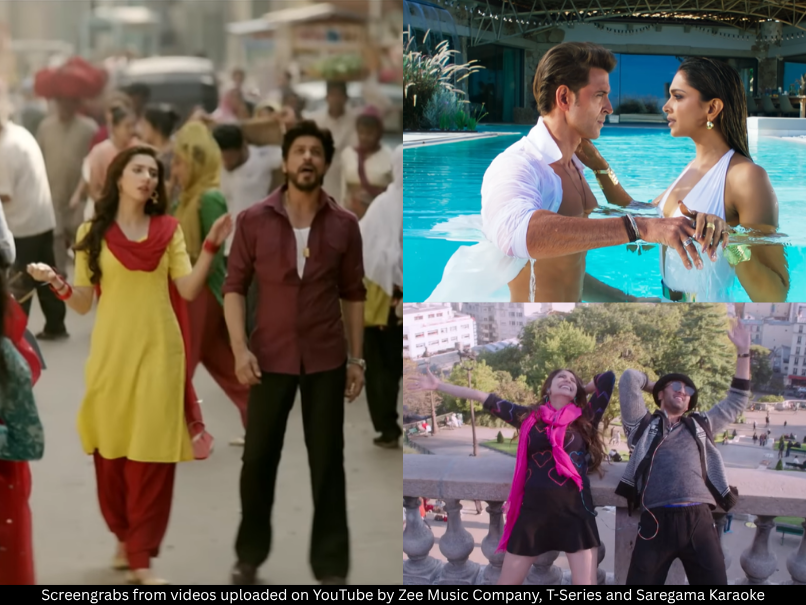
Deleted songs did not disappear with black-and-white cinema. Karan Johar’s ‘Ae Dil Hai Mushkil’, released on October 28, 2016, starred Ranbir Kapoor, Anushka Sharma, Aishwarya Rai Bachchan and Fawad Khan. For one sequence, Ranbir and Anushka recreated the title number from Shammi Kapoor’s 1967 film ‘An Evening in Paris’. The original recording was sung by Mohammed Rafi, composed by Shankar-Jaikishan and written by Hasrat Jaipuri.
The pair danced through Paris while listening to the classic on shared earphones, turning Ayan and Alizeh’s friendship into a cheerful tribute to old Hindi cinema. The complete sequence was removed, reportedly to reduce the film’s length, although a brief snatch of the song remained in the background. Unlike most older entries on this list, the footage did not vanish into an archive: Karan Johar officially released the deleted video online a week after the movie opened.
15. Halka Halka - Raees
Rahul Dholakia’s ‘Raees’, released on January 25, 2017, starred Shah Rukh Khan, Mahira Khan and Nawazuddin Siddiqui. ‘Halka Halka’ was filmed as a breezy romantic interlude tracing the growing affection between Raees and Aasiya. The song was composed by Ram Sampath, written by Javed Akhtar and sung by Shreya Ghoshal, Sonu Nigam and Sampath.
The fully filmed number was left out during editing, reportedly because it did not fit the pace and shape of the final narrative. Fortunately, audiences did not have to wait decades to discover it: the makers released the video online on February 6, 2017, while ‘Raees’ was still playing in cinemas. With Shah Rukh and Mahira exchanging glances amid Gujarat’s colourful surroundings, it offered a softer chapter in a film otherwise driven by bootlegging, crime and political ambition.
16. Bekaar Dil - Fighter
Siddharth Anand’s ‘Fighter’, released on January 25, 2024, starred Hrithik Roshan, Deepika Padukone, Anil Kapoor, Karan Singh Grover and Akshay Oberoi. Filmed on Hrithik and Deepika, ‘Bekaar Dil’ was a glamorous romantic number composed by Vishal-Shekhar, written by Kumaar and sung by Vishal Mishra, Shilpa Rao, Vishal Dadlani and Sheykhar Ravjiani.
The song was absent from the Indian theatrical version, although reports indicated that it appeared in some international prints. Its omission became especially noticeable after clips circulated online, prompting the makers to release the complete video digitally after the film arrived in cinemas. Reports connected its removal to concerns over the intimate visuals, although the publicly reported CBFC changes referred specifically to replacing eight seconds of “se**ally suggestive” footage. It is therefore safer not to claim that the certification board definitively ordered the entire song to be deleted. However, some reports suggested it was later added back to the Indian theatrical version as well.
A deleted scene can occasionally be restored, but a lost musical sequence carries a different kind of fascination. The voices, orchestration and lyrics allow listeners to hear what might have been, while the absent images invite endless speculation. Censors, editors, producers and even late-returning audiences may have removed these songs from their films, but records, radio, concerts and the internet ensured that many of them ultimately outlived the reasons they were cut.