Shot Once, Made Twice! Bollywood Films That Had To Be Reshot
From casting changes to rewritten climaxes, discover why Bollywood films such as ‘Jo Jeeta Wohi Sikandar’, ‘Tumbbad’ and ‘Laadla’ were reshot.

IST
Last Updated On
IST
“It’s a wrap” sounds wonderfully final. The actors move on, the sets come down and the footage heads towards the edit. Except, sometimes, somebody watches that footage and realises the film needs a second chance before the audience gets its first. Back come the cameras, the costumes and, occasionally, an entirely different actor. Bollywood has several such stories, ranging from creative overhauls and casting changes to productions rebuilt after tragedy.
In a few unusual cases, the cameras started rolling again even after the film had reached cinemas. These films involved substantial reworking – a major character’s portions, large stretches of the narrative or a crucial climax – rather than an ordinary retake.
Here are the Bollywood films whose journeys to the screen came with a significant second attempt:
1. Jo Jeeta Wohi Sikandar
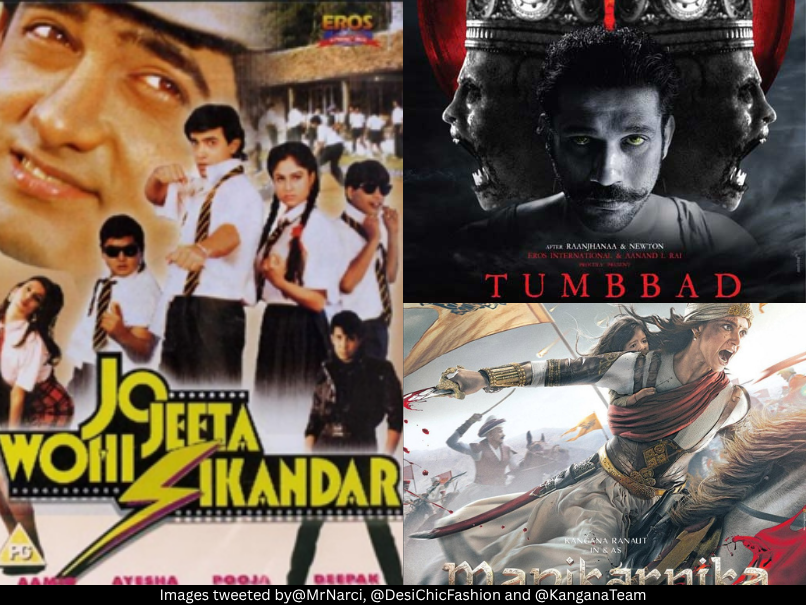
Before Sanju could win that cycling race, the filmmakers had quite a mountain to climb themselves. Released on May 22, 1992, Mansoor Khan’s coming-of-age drama starred Aamir Khan, Ayesha Jhulka, Deepak Tijori, Pooja Bedi and Mamik Singh. But the familiar cast was not the one with which the production began. In a 2025 interview, Aamir recalled that considerable filming had already taken place when Mansoor decided the original casting of Devika was wrong: the character needed a snooty edge that was not coming through. Pooja Bedi subsequently took over the role.
Aamir described the upheaval as the film being made twice. Mansoor, in a separate interview, estimated that nearly 60–70 per cent had to be reshot, acknowledging his casting mistakes and difficulties with members of the original unit. Deepak Tijori also replaced Milind Soman as Shekhar. While the recollections differ over the precise scale, they agree on the extraordinary extent of the restart. For a film about recovering from setbacks, its making offered quite a real-life parallel.
2. Tumbbad
Tumbbad’s rain-soaked world looks painstakingly built because, in parts, it was built more than once. Released on October 12, 2018, the horror fantasy was directed by Rahi Anil Barve, with Adesh Prasad credited as co-director, and featured Sohum Shah and Mohammad Samad. Its story follows Vinayak’s increasingly dangerous pursuit of a treasure guarded by Hastar. Cinematographer Pankaj Kumar told Scroll that he and Barve had shot the entire film in the first schedule, but the team felt the result could be better.
That dissatisfaction led to rewriting, additional scenes and extensive reshooting. Pankaj Kumar put the footage reshot during the second schedule at about 30 per cent, alongside extra material, and recalled rebuilding sets at greater expense. The goddess’s womb-like chamber was a new addition; the earlier conception had been a dark room. Sohum separately described a production that evolved over roughly six years, including lengthy visual-effects work. One of the film’s most striking spaces, then, emerged because the makers were willing to rethink what they already had.
3. Crazxy
Usually, audiences react to a film and the filmmakers take those lessons into their next project. Sohum Shah and director Girish Kohli responded rather more quickly. Their thriller ‘Crazxy’, released on February 28, 2025, follows a doctor racing to save his kidnapped daughter. Sohum carries the central on-screen performance, with Nimisha Sajayan, Shilpa Shukla and Tinnu Anand among the voice cast. But the original climax did not deliver the impact the team had hoped for.
Speaking to Mid-day, Sohum acknowledged that viewers had found the ending underwhelming, something the makers also picked up from reviews. They brainstormed a change and returned to shoot in Madh Island on the Monday after release. The revised version reached cinemas on March 7, 2025, just a week after the original opening. Sohum credited the speed partly to being both actor and producer, allowing him to make the decision quickly. Imagine discussing a thriller with a friend, only to discover that their screening came with a different finish.
4. Laadla
Some reshoots begin with creative dissatisfaction. Laadla’s circumstances were far more heartbreaking. Raj Kanwar’s drama, eventually released on March 25, 1994, starred Sridevi, Anil Kapoor and Raveena Tandon, with Farida Jalal among the supporting cast. The role of formidable businesswoman Sheetal had originally been played by Divya Bharti, who died on April 5, 1993, before the film could be completed.
Writer Anees Bazmee has repeatedly recalled how much work had already been done. In an interview reported in August 2026, he estimated that 90–95 per cent of the film was complete, with the climax still pending. Sridevi’s arrival meant an extensive restart and reshooting the lead character’s material. Anees Bazmee also explained that he made script adjustments before approaching her, having learnt that she had declined earlier Tamil and Telugu adaptations of the story. Behind the film audiences eventually watched was a unit trying to recover from a loss while finding a way to finish its work.
5. Trishul
With Yash Chopra directing, Salim–Javed writing and a cast featuring Amitabh Bachchan, Sanjeev Kumar, Shashi Kapoor, Hema Malini and Raakhee, ‘Trishul’ had formidable talent behind it. The revenge drama, released in May 1978, nevertheless required substantial reworking. Producer Gulshan Rai’s son Rajiv Rai recalled that his father felt the first version did not present Amitabh Bachchan’s character strongly enough. According to Rajiv, Gulshan demanded fresh dates from the star, warning that he would otherwise abandon the film. Rajiv estimated that almost half was reshot.
There is another account to consider. Diptakirti Chaudhuri’s book Written by Salim-Javed describes the writers and director recognising that the footage was not working and seeking additional shooting to improve it. The ambulance sequence, in which Vijay clears out a property occupied by goons, was among the additions discussed in that account. The recollections differ over who drove the rescue operation, but the broader point is consistent: a film now associated with Big B’s commanding screen presence needed significant work to get there.
6. Mahaanta
Released on May 23, 1997, Afzal Khan’s ‘Mahaanta’ featured Sanjay Dutt, Madhuri Dixit, Jeetendra and Amrish Puri. Its lengthy production became more complicated after Sanjay Dutt’s imprisonment interrupted filming. In an interview with trade magazine Film Information, Afzal Khan said approximately 75 per cent had been completed when Sanjay Dutt was jailed. After the actor returned, the director watched footage following a song shoot and realised the finished film would suffer from serious continuity problems if he simply carried on.
The solution was substantial: Film Information reported that about 60 per cent of the film had been reshot. Afzal Khan said the new shooting took place between July and October 1996, and again that December. He also used the opportunity to adjust the script and reduce some other performers’ footage. His account captures how a prolonged interruption can change the job entirely: finishing the remaining scenes was no longer enough; much of the existing film needed to be made to fit again.
7. Manikarnika: The Queen Of Jhansi
The battle behind ‘Manikarnika’ became almost as widely discussed as the one on screen. Released on January 25, 2019, the historical drama credited Kangana Ranaut and Krish as directors and starred Kangana, Ankita Lokhande, Jisshu Sengupta, Atul Kulkarni and Mohammed Zeeshan Ayyub. During the later stages of production, Sonu Sood exited, and Ayyub took over his role of Sadashiv Rao. Material already filmed with Sonu Sood consequently had to be shot again.
Kangana took charge of the later filming, with Mid-day reporting describing a 45-day schedule involving reshoots of key portions. The reasons and extent became the subject of a public disagreement: Krish maintained that he had substantially completed his version, while Kangana and the production’s accounts described the work required to finish the film differently. What can be stated without taking sides is that an actor’s entire character track was recast and significant filming followed under Kangana’s direction.
8. Fitoor
Replacing an actor before filming is one thing. Replacing one after their scenes have been shot means calling other people back too. That was the challenge for Abhishek Kapoor’s ‘Fitoor’, released on February 12, 2016, starring Aditya Roy Kapur, Katrina Kaif and Tabu. In the adaptation of Charles Dickens’ ‘Great Expectations’, Rekha had originally played Begum, the character inspired by Miss Havisham. Her departure meant her sequences had to be filmed again with Tabu, including material involving the younger leads.
Reports offered various explanations for Rekha’s exit, but Abhishek Kapoor’s own account was that they had begun seeing things differently and mutually decided against continuing together. He also rejected speculation linking the decision to supposed similarities between Rekha’s life and the character. Tabu, he said, came aboard within three days. Crucially, Abhishek Kapoor maintained that the character’s track had not changed: the same part would now receive a different actor’s interpretation.
9. The Sabarmati Report
Released on November 15, 2024, ‘The Sabarmati Report’ starred Vikrant Massey, Raashii Khanna and Ridhi Dogra, with Dheeraj Sarna receiving the final directing credit. Ranjan Chandel had originally directed the project, which follows journalists investigating the 2002 Godhra train-burning incident. After the producers watched the first cut, they wanted portions redone and new material introduced. That decision ultimately led to a change behind the camera.
Producer Amul Mohan told Mid-day that the team wanted to enrich the existing film by redoing certain elements and adding key ones, even though doing so increased the budget. Ranjan Chandel did not agree with the proposed changes, and Sarna, who also worked on the dialogue, came in. Ranjan Chandel separately confirmed that creative disagreement over the requested changes had prompted his departure.
10. Mehndi
Long before ‘Crazxy’ revised its theatrical ending, ‘Mehndi’ had tried a similar post-release intervention. Directed by Hamid Ali Khan and released on November 13, 1998, the social drama starred Rani Mukerji and Faraaz Khan, alongside Himani Shivpuri and Shakti Kapoor. Its story centres on a woman fighting back against mistreatment by her husband and in-laws over dowry.
A Film Information report dated January 23, 1999, subsequently republished in its archives, recorded that producer Salim Akhtar had shot a new climax and released the revised version. The item assessed whether the change had improved audience response, suggesting that reception was the concern, although it did not record a detailed creative explanation from the producer. Its verdict was sobering: the response was reportedly much the same as before. A new ending had given the film another outing, but had apparently done little to change its fortunes.
11. Pakeezah
The sumptuous colours of ‘Pakeezah’ were not part of its original plan. Kamal Amrohi’s musical drama, released on February 4, 1972, starred Meena Kumari, Raaj Kumar and Ashok Kumar, with Veena and Nadira among the supporting cast. Its tale of a courtesan yearning for love and acceptance began filming in 1956 in black-and-white. As Film Heritage Foundation records, Amrohi subsequently decided to switch to Eastmancolor in 1958, setting the production on a different visual path.
Cinemaazi documents that existing scenes were reshot in colour, followed by another round of reshooting as Amrohi adopted CinemaScope. Scroll’s recent retrospective corroborates those changes. The production also endured interruptions, script and casting changes, and the separation of Amrohi and Meena Kumari, stretching its journey across roughly fifteen years. Amid all those setbacks, the filmmaker kept revisiting how his world should look on screen. The rich hues and expansive compositions audiences now associate with ‘Pakeezah’ emerged through a production willing to abandon an earlier visual version and begin again.
12. Mughal-e-Azam
It is difficult to imagine ‘Mughal-e-Azam’ without Prithviraj Kapoor, Dilip Kumar and Madhubala, but its first incarnation featured entirely different performers in those roles. Released on August 5, 1960, K. Asif’s historical epic also starred Durga Khote, building its drama around Prince Salim’s love for Anarkali and his confrontation with Emperor Akbar. The original production in the 1940s had Chandramohan as Akbar, Sapru as Salim and Nargis as Anarkali. Its troubled journey involved a prolonged interruption and the loss of its original financial backing following Partition.
Chandramohan’s death created another major obstacle. Anupama Chopra’s account in Open records that ten reels had been shot before his death forced the film to restart. With Prithviraj taking over Akbar, Asif also rebuilt the central casting around Dilip Kumar and Madhubala, under new backing from Shapoorji Pallonji. The reshooting therefore belonged to a much larger reconstruction of the project. Before the famous father-son confrontations and forbidden romance could become film history, an earlier version had to be left behind.
13. Angrakshak
‘Laadla’ was not the only production that had to return to the cameras after Divya Bharti’s death. Ravi Raja Pinisetty’s ‘Angrakshak’, released on November 17, 1995, eventually starred Sunny Deol and Pooja Bhatt, alongside Kulbhushan Kharbanda and Saeed Jaffrey. Divya had originally been cast as the female lead, and considerable work had already been done with her before she died in April 1993. Pooja subsequently took over, requiring the affected material to be filmed again.
Writer Anees Bazmee, recalling the circumstances in an interview reported in August 2026, explicitly named ‘Angrakshak’ alongside ‘Laadla’ as a film that required reshooting because of the tragedy. In his recollection, ‘Angrakshak’ had already been completed with Divya. It was a difficult restart for a production that had already invested in its original pairing. For the team, casting Pooja meant reconstructing work already performed with another actor; the film finally reached audiences more than two years after Divya’s death.
14. Kartavya
Released on September 29, 1995, Raj Kanwar’s ‘Kartavya’ starred Sanjay Kapoor and Juhi Chawla, with Amrish Puri, Aruna Irani and Moushumi Chatterjee in the ensemble. But Juhi had not been the original female lead. Sanjay initially filmed opposite Divya Bharti, and later recalled that approximately 40 per cent of the film had been shot before her death. Juhi stepped in afterwards, and the replacement meant revisiting material involving the leading lady.
Sanjay’s memories make the reshoot particularly tangible. Looking back on the film, he said that he had first shot ‘Hame Kya Khabar Thee’ with Divya, before the project was completed with Juhi. He also expressed gratitude to Juhi for agreeing to work opposite him when she was already an established star and he was a newcomer. A song that became part of the finished film therefore carried a very different memory for its hero: he had performed it earlier with the co-star the production had lost.